Ultima III: Exodus

Ultima III: Exodus, is the third game in the series and the last installment of the “Age of Darkness” trilogy. It was published and released in 1983 by Origin Systems for the Apple II, C64, 8-bit Atari and IBM PC. Later ports for the Macintosh, Atari ST and Amiga with enhanced graphics followed.
Gameplay[edit]


Compared to Ultima II, the complexity and seriousness of the game is clearly much more developed. The story of the game is much more straight-forward, and more puzzle-solving is involved. This is a turning point in the Ultima games – a big step from the hack-n-slash of the earlier installments.
The world of Sosaria has become more complex, with the player now guiding a party of four. This is the first Ultima game to constrain the player's vision to line-of-sight. To this end, any parts of the overhead view are blanked out, if the party should be unable to see them due to obstructions.
For details about character attributes in this game, see Character attributes in Ultima III.
The Story[edit]
Spoiler warning: Plot and/or ending details follow.
After the end of Mondain and Minax, the people of Sosaria are allowed to believe that the evil, and all its aftereffects, have been eliminated. Exodus, their offspring and creation, whose very nature is difficult to classify, wants vengeance for the destruction of its creators. Beginning a campaign of terror, an island arises from the sea and evil creatures and pirates begin to invade the land.
The player returns as the Stranger for a third time to save the world from this new evil. This time however, the hero has three companions to survive against Exodus' hordes. Together, they travel through the land, solving the mysteries of Exodus and its fortress, before finding the Four Cards on the lost island of Ambrosia. With the help of the Time Lord, the group is able to learn the secret of Exodus' vulnerability. After recovering the Exotic Weapons and Exotic Armour, they make their final assault on the Isle of Fire. Bypassing the Great Earth Serpent and then fighting their way through the minions of Exodus, they finally arrive at the core – the part of Exodus that is a computer. Inserting the cards, the machine explodes and Exodus is no more a threat to the land (its essence later appears in other worlds).
Spoilers end here.
Development[edit]
The graphics, especially in the dungeons, are now more detailed than previous Ultima games and is the first to feature music, for hardware that supports it.
Differences Between Platforms[edit]
- Main article: Computer ports of Ultima III
The various ports of Ultima III are quite different. While the ports for the Apple II and C64 both look the same and have the full music (hardware-permitting), the PC-port has CGA graphics and no music at all. The later released ports for the Amiga and Atari ST have better graphics, full music and even a user-friendly mouse interface. A special Macintosh-port was developed later, with much improved graphics.
The Nintendo-port differed greatly from all PC variants of the game and has a visual style more reminiscent of classical Japanese RPGs, in addition to a completely different soundtrack. Gameplay also functioned differently to account for the use of a console controller – and incorporated streamlined status displays and comprehensive menu-systems to allow players to input commands.
Music[edit]
This was the first Ultima to include a musical score; it was written by Ken Arnold, whose work also appeared in later Ultimas. The C64 and Apple II versions offered a complete soundtrack for systems with appropriate hardware; the PC version did not offer music, but fans created a patch that added the songs from the other versions.
Translations[edit]
French publisher Ediciel had Pierre Rosenthal create the first French translation of any Ultima, and released the finished game for the Apple II in 1985. It came in a small, book-like plastic box containing Ultima III on cassette, documentation in French, and a small paper map whose colors were strangely shifted so that the formerly-green land now was red.
See also Translations of Ultima games.
Release[edit]
Exodus was a hit game in 1983, and sold very well, thus giving Origin a very good start, and the needed money to create the next installment of the series. Ultima III was even voted the third most-popular Apple II game of all time by Softline in 1984.[1] Many game creators of that time used Ultima III as a reference when creating their own RPGs.
Memorable is the release of the French version by Ediciel. While being an ordinary Apple II version, the cover is radically different, as are the documantation and the included map, the latter showcasing psychedelic colors.
The game was later released in several compilations:
- Ultima Trilogy I II III (1989)
- Ultima Value Pak (1990) as part of the Ultima Trilogy I
- Ultima I-VI Series (1993)
- Ultima Collection (1998)
In Japan, the game got included in the compilation Ultima Complete.
Included with the game[edit]
The release of Ultima III included these things with the game:
- The Book The Book of Play.
- The Book The Ancient Liturgy of Truth.
- The Book The Book of Amber Runes.
- The Player Reference Card.
- A cloth map of Sosaria.
- Advertisement for Secrets of Sosaria.
There also were more obscure items associated with the game.
- The Ultima III jigsaw puzzle came with the game in Japan, produced by StarCraft.
- Pony Canyon sold Exodus T-Shirt and Wrist Watch items for promotion of the MSX2-port in 1988.
There were a series of unofficial expansion packs created by Joel Fenton of Backstreet Software between 1984/1985, which were marketed under the name Ultimore.
Upgrades[edit]
MS-DOS Upgrade Patch[edit]
A fan-made Ultima III upgrade patch exists which converts the CGA graphics to 256-color VGA graphics, inserts the music from other ports, builds in a frame-limiter, fixes a number of bugs, and inserts new commands into the game.
C64 Upgrade[edit]
Ultima III Gold is a patched version of Ultima III for the Commodore 64, which fixes numerous bugs, and introduces a number of speed-optimizations and user-interface enhancements. See Ultima III - Exodus on C64 Wiki
[edit]
While there was an official Macintosh-port of Ultima III made by Origin in 1986, a 3rd-party firm named Lairware created a vastly modernized shareware port in the early 1990s. They have continued updating it, recently adding OS X compatibility.
Game Boy Color-Port[edit]
There is also a Game Boy Color-port created by Sven Carlberg in 2001.
More Game Related Information[edit]
- NPCs
- Spell list
- Walkthrough
- Character attributes
- Cheating in Ultima III
- Ultima III Real-life references and Easter eggs
- Ultima III internal formats
- Ultima III monster data
- Ultima III transcript
- Ultimatrix – map viewer
- Ultima Saved Game Editor
Trivia[edit]
- Ultima III was Origin Systems' first product, as well as being the first Ultima to feature a party and to direct winning players to mail the company and receive a completion certificate.
- The Ultima III box art is a painting by veteran Ultima artist Denis Loubet. However, the cover was originally to feature a similarly-themed piece (seen below) by Richard Garriott's mother, Helen.[2] While this artwork was not seen in the final release, she did contribute the drawing used for the cloth map of Sosaria included with the game.
- According to Dr. Cat (David Shapiro), the launch of Ultima III was celebrated at a Denny's, and this was coincidentally during a time when the restaurant was marketing its bacon burgers as "British burgers."[3]
- Origin became a target for groups suspecting Satanic contents in computer games, because of the demon Exodus on the cover of the game-box.
- When coming up with the name for Ultima III, Origin at first did not know what the word "Exodus" meant. It was just a cool-sounding name for the main villain.
- The NES-port of the game can be completed without gathering the cards, and by a party of characters possessing fewer than eight levels of development. This is achieved by using the moongate that strands the party on the island of Exodus blocked by water on one end, and mountains on the other. The player must then pass his turn over to be teleported again and again by the moongate until a pirate ship is spawned within the few water-tiles on the interior area of the island. The ship can be taken over and from then by using the ship, the castle can be reached. When the final chamber is conquered, the end-credits will be displayed.
- In Ultima V: Lazarus, a tombstone near the Bloody Plains has a humorous reference to Ultima III's plot:
- A one-episode anime was produced in Japan for the NES-port, but never broadcast.
- Ultima III inspired many video game authors, that created similar games, although most of them ended up being more similar to Ultima II.
Gallery[edit]
Back cover
An Ultima III advertisement
Early Origin advertisement
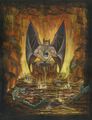
Helen Garriott's Ultima III cover art

Ediciel box art

Back of the Ediciel box


External Links[edit]
- The collectible Ultima – Ultima III
- Graphics upgrade and music patch for Ultima III
- Nitpicks for Ultima III
- Ultima III on Ultima Aiera
- A modernized port for classic and OS X Macintoshes
- Ultima III: Exodus on Wikipedia
- Ultima 3 for the Gameboy Color
- Ultima III – Exodus on C64 Wiki
References[edit]
- ↑ Softline, Volume 3.4. March - April 1984. Page 49.
- ↑ Garriott, Richard. “Richard Garriott on Twitter”. Twitter. 2015-11-20. Retrieved 2015-11-21.
- ↑ Matt Barton. “Matt Chat 362: Dr. Cat on Origin Systems”. Matt Barton. 2016-12-11. Retrieved 2017-03-02.