Origin

Origin Systems, Inc. (frequently abbreviated as OSI) was an influential American video game developer and publisher active from 1983 to 2004. Based primarily in Austin, Texas, the company is renowned for creating seminal computer role-playing games and simulation franchises, most notably the Ultima series and Wing Commander. Famous for its corporate motto, "We create worlds," Origin was recognized throughout the 1980s and 1990s for pioneering detailed game worlds, innovative physical packaging, and technical breakthroughs in dynamic audio and 3D graphics.
History[edit]
Founding and Early Growth (1983–1992)[edit]
The company was founded in 1983 by brothers Robert and Richard Garriott ("Lord British"), their father Owen, and Chuck "Chuckles" Bueche after Richard had terminated his contract with Sierra Online to publish the third part in Richard's Ultima series, Ultima III. The reason for severing ties with Sierra was never officially stated beyond disputes over royalties for the PC-port of Ultima II, though over the years hints emerged that Garriott was frustrated with Sierra's staff and repulsed by how Sierra's founder Ken Williams had tried to get a tight grip on Garriott's intellectual property.
At the beginning, Origin was a small operation, operating out of the Garriott house and the attached garage. When the topic of expansion came up, Origin moved to New Hampshire in 1984, in order to take advantage of the large number of young computer programmers in the area, which would make developing a software house much easier. Origin would not return to Austin in Texas until 1989. Origin produced many successful games including the Ultima series, Wing Commander series, Strike Commander, Crusader, System Shock, and Wings of Glory. They were famous for accessories like manuals and maps that came with their games, putting emphasis on immersion.
Electronic Arts Acquisition and Transition (1992–1999)[edit]
However, in the summer of 1992, Origin came into serious financial problems. The market for home computer ports had vanished rather abruptly, leaving Origin with its remaining stocks of these ports. Also the re-tooling of the distribution pipeline for the IBM PC had cost them many resources. Securing a loan proved impossible due to the concurrent Texas banking crisis. In September 1992 Electronic Arts (EA) acquired the company.
Although Origin staff initially believed the acquisition would provide new resources, EA quickly moved to streamline the company to increase profits and gave them deadlines for the games, that often were impossible to meet, causing Ultima VII Part Two, but especially Ultima VIII, to lose numerous plot elements just because there was not any time to finish them. Ultima IX even was pretty much crippled because of the deadline being far too tight, resulting in a bug-ridden game with an emergency-plot created at the last minute.
In 1997, they released one of the earliest and most successful graphical massively multiplayer online role-playing game: Ultima Online. After this title, Electronic Arts decided that Origin would become an online-only company after the completion of Ultima IX in 1999. However, within a year's time, EA cancelled all of Origin's new development projects, including Ultima Online 2, Privateer Online, and Harry Potter Online. Richard Garriott left Origin shortly after and founded Destination Games in 2000.
Online Era and Closure (1999–2004)[edit]
In later years, Origin mainly existed to support and expand Ultima Online and to develop further online games based on the Ultima franchise such as Ultima X, originally to be released in 2004 but later cancelled. In February 2004, the studio was disbanded by Electronic Arts.
Logo Gallery[edit]
Officially, Origin only had three logos in its history. However, the second logo is sub-divided further in the games themselves due to going through a significant change in 1991. Therefore the gallery below speaks of four logos.
Logo in the games

Third logo (Ultima VII–VIII) 1991–1996

Fourth logo (Ultima IX, Ultima Online) 1996–2004


Official print logo

Print version of the first logo, 1983–1988

Print version of the second and third logo, 1988–1996

Print version of the fourth logo, 1996–2004


Characteristics[edit]
Origin's motto was "We create worlds" and its games were known for their well-realized (if not always creative) plots and the amount of detail furnished into the game's stories.
The original Wing Commander, for instance, came with a booklet purported to be a shipboard magazine named Claw Marks, written and published by the crew of the Tiger's Claw (ghost-written by Aaron Allston); it provided the player with flavoring (such as an interview with the star of a popular televised wartime drama) as well as convenient statistics and user guides for ships, weapon systems, and information regarding pilots and tactics for both Terran and Kilrathi forces, as well as background lore. Claw Marks was actually a fairly rare commodity on eBay before it was re-released as part of the Kilrathi Saga packaging.
List of Games[edit]
| Year | Ultima | Wing Commander | Other |
|---|---|---|---|
| 1983 | Ultima III: Exodus | — | Caverns of Callisto |
| 1985 | Ultima IV: Quest of the Avatar | — | Moebius: The Orb of Celestial Harmony |
| 1986 | Ultima I Remake - The First Age of Darkness | — | Autoduel
Ring Quest |
| 1988 | Ultima V: Warriors of Destiny | — | Times of Lore |
| 1989 | — | — | Knights of Legend |
| 1990 | Ultima VI: The False Prophet | Wing Commander
Secret Missions |
Bad Blood |
| 1991 | Worlds of Ultima - Martian Dreams | Wing Commander II: Vengeance of the Kilrathi
Special Operations |
— |
| 1992 | Ultima Underworld: The Stygian Abyss | — | — |
| 1993 | Ultima Underworld II: Labyrinth of Worlds
Ultima VII Part Two: Serpent Isle |
Wing Commander Academy | ShadowCaster |
| 1994 | Ultima VIII: Pagan | Wing Commander III: Heart of the Tiger | Metal Morph |
| 1995 | — | — | BioForge |
| 1996 | — | Wing Commander IV: The Price of Freedom | Crusader: No Remorse |
| 1997 | PSX-port of Ultima Underworld | Wing Commander: Prophecy
Secret Ops |
— |
| 1999 | Ultima IX: Ascension | — | — |
Trivia[edit]
- Origin was also known for their colorful Origin catalog, through which the various games, books and merchandise could be bought. The catalog was quite expensively made for its time.
- The star in Origin's logo was used for the logo of the Terran Confederation in the Wing Commander universe as an in-joke by the creators.
In-Game Logo Gallery[edit]
This gallery illustrates how various Origin logos appeared in the Ultima-games themselves without any alteration. Ports different from the PC are only shown if there is a significant difference in resolution or presentation.
For Ultima I, only the 1986 release featured an in-game logo, as the original 1981 game predated Origin's founding. Ultima II as well was created before Origin was founded. Ultima III and Ultima IV had simple text which doesn't count as a logo. For some reason, Savage Empire is missing a logo. Interestingly, in Ultima VII and Serpent Isle, the logo was only found in the credits, while the logo for some reason was simplified for Ultima VIII.
Of all the console ports, only the NES-port of Ultima V and PSX-port of Ultima Underworld feature a logo. The logos, if applicable, are the same in the Japanese ports as in the original games, but there are exceptions. For Ultima V, here the logo used in the PC-98 and Sharp X68000 ports—though retaining the original rotation animation—is the updated star logo, Ultima I has the new logo and Ultima II, which in the original was before Origin's time, has the same logo as Ultima I.
The Origin logo in Ultima Online was cut out in later editions of the game after Origin was closed by EA.
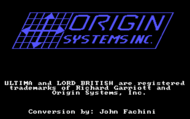
The in-game logo in Ultima I.
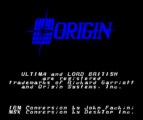
The in-game logo in Ultima I on the MSX, PC-88 and PC-98.
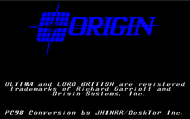
The in-game logo in Ultima II on the MSX, PC-88 and PC-98.

The in-game logo in Ultima V.

The in-game logo in Ultima V on the C64.

The in-game logo in Ultima V on the PC-98 and Sharp X68000.
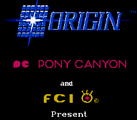
The in-game logo in Ultima V on the NES.

The in-game logo in Ultima VI.

The in-game logo in Ultima VI on the C64.
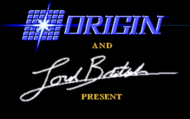
The in-game logo in Martian Dreams.
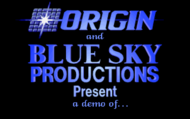
The in-game logo in the Ultima Underworld demo.

The in-game logo in Ultima Underworld.

The in-game logo in the PSX-port of Ultima Underworld.
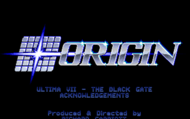
The in-game logo in Ultima VII.

The in-game logo in Ultima Underworld II.

The in-game logo in Serpent Isle

The in-game logo in Ultima VIII.

The in-game logo in Ultima Online.

The in-game logo in Ultima IX.


External Links[edit]
- The Collectible ULTIMA: Origin history
- Origin Systems – on MobyGames
- The Origin Museum
- The Conquest Of Origin – in The Escapist
- Origin Systems – on the Star Citizen Wiki
| Companies involved with the Ultima series | |
|---|---|
| The Main Studio | Origin Systems Inc. |
| Western Companies | California Pacific Computer Co. ☥ Electronic Arts ☥ Looking Glass Studios ☥ MicroProse Mindscape ☥ Sierra On-Line, Inc. ☥ The Software Toolworks Inc. |
| Japanese Companies | Fujitsu Ltd. ☥ PonyCanyon Inc. ☥ StarCraft Inc. |